


Aluminum Retractable Roofs: The Smartest Waterpark Investment
Is an Aluminum Retractable Roof Building the BEST Solution for Indoor Waterparks?

I’m an architect with an MBA, and for the past 13 years I’ve worked with OpenAire on nearly every waterpark project the company has built. That combination, design training and a business lens, has put me in the room for two very different conversations that happen on every project: “will this work architecturally?” and “will this work financially?” This post is my honest answer to both, based on real projects, not marketing copy.
The Biggest Misconception: Cost
The assumption I hear most often, almost automatically, from developers and construction teams is that an aluminum retractable roof building will cost more than a standard structure. In my experience, it doesn’t.
A clear example: on the Showboat Resort’s Island Waterpark project, the construction management team ran a direct cost comparison between an OpenAire aluminum retractable roof building and a standard fixed structure. The two came out on par. Same price, upfront.
The real difference shows up later, in what you don’t have to pay for. The most common alternative to aluminum is steel, and steel corrodes. In a waterpark environment, constant humidity, chlorine, splashing water, that corrosion isn’t a minor cosmetic issue. Steel structures need ongoing repainting, refinishing, and repair anywhere the paint chips or rust sets in. Aluminum doesn’t corrode. You’re not comparing “cheaper vs. more expensive”, you’re comparing “pay now, or pay forever.”
The Long-Term Numbers: Energy and Maintenance
Beyond the upfront cost parity, the operational savings are where aluminum retractable roofs really separate themselves:
Energy savings of 10% and more, year over year. When the roof is open, mechanical ventilation systems largely shut down, at most, you’re running fans to move air around, not full HVAC and dehumidification systems.
Indoor temperatures run about 8–10°F cooler than a closed, mechanically-ventilated waterpark when the roof and walls are open, simply through natural airflow.
Little to no superstructure maintenance. Unlike a steel building, which needs to be repainted or refinished wherever corrosion or chipped paint shows up, an aluminum structure doesn’t need that ongoing upkeep.
None of this comes at the expense of design flexibility. A retractable roof waterpark supports the exact same slides, lazy rivers, play structures, and attractions you’d find in any other waterpark. There’s no functional tradeoff, the difference is entirely in what the building costs you (and doesn’t cost you) over time.
The Guest Experience Difference
As an architect, this is the part I care about most: what a retractable roof actually lets you design.
Traditional indoor waterparks have a reputation, and it’s not a flattering one. They tend to feel like dark warehouses: enclosed, humid, dim, with poor air quality. An aluminum retractable roof building solves that at the source. You get a bright, naturally lit space with genuinely fresh air, not a mechanically-conditioned approximation of it. It’s simply a space people like to spend time in, and that matters more than most cost-benefit spreadsheets capture.
The Engineering Has Scaled Up
Over 13 years, I’ve watched this technology evolve to keep pace with what waterpark attractions actually demand. Today, OpenAire’s retractable roof buildings span roughly 185–190 feet wide (length is essentially unlimited), and support slide towers reaching 90–100 feet tall. Whatever ambitious vertical or spatial vision a park wants to build, the structure now supports it, that wasn’t always the case in the earlier years of this product.
It Performs in Any Climate
The other objection I hear constantly: how does a moving roof hold up in extreme weather? The answer is that every OpenAire building is engineered specifically for the climate and geography it sits in, not a one-size-fits-all design.
A few examples:
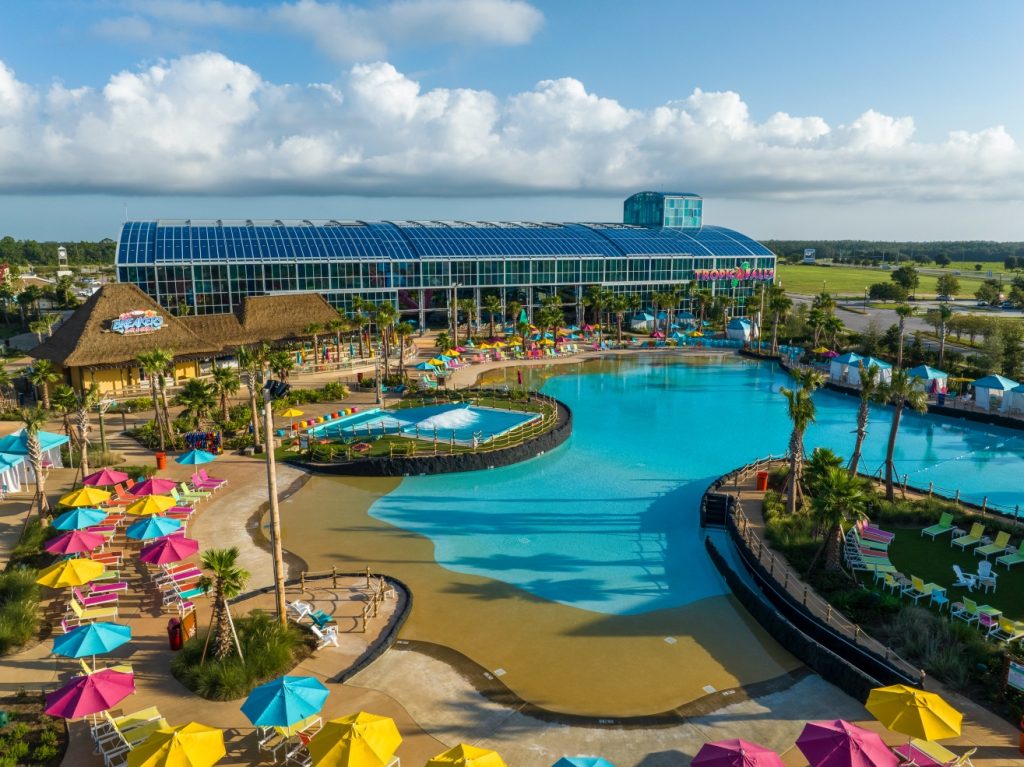
Tropic Falls Waterpark in Foley Alabama: a waterpark that has weathered multiple hurricanes, engineered for very high wind loads.
The Pump House at Jay Peak, Vermont: a waterpark built directly into a mountainside, facing some of the heaviest snow loads in the industry.
In all of these cases, there’s been no impact on the operation or function of the waterpark. The roof performs exactly as designed, regardless of the geography around it.
The ROI Case
From a business standpoint, here’s the honest picture: the upfront capital cost of an OpenAire aluminum retractable roof building is on par with a standard structure of the same size, from any other supplier. The return comes afterward, in two forms:
Lower operating costs: the 10%++ energy savings and near-zero superstructure maintenance described above.
More consistent revenue: because the building functions as both an indoor and an outdoor park, it never suffers closures or rain delays. That means more days open, more consistently, than a purely outdoor or purely enclosed alternative.
Is There a Real Alternative?
To be fair and balanced: there are other companies that build retractable skylights, but at a much smaller scale, typically sized for restaurants or small patios, not large-span structures. At the scale a waterpark actually requires, there isn’t another company building aluminum structures at OpenAire’s scale.
The real-world alternative most developers are actually choosing between is a standard steel building, essentially a warehouse structure. And the problem with that alternative comes back to the same issue: corrosion. A waterpark is a highly corrosive environment, and that has to be accounted for in the construction, not treated as an afterthought. As I tell people on these projects: this is not the same as building a Walmart.
The Bottom Line
The waterpark industry has changed. Aluminum retractable roof construction isn’t brand new, but it’s a newer approach that has meaningfully evolved how indoor waterparks are, and should be, built going forward. And that matters because waterparks aren’t being built for five- or ten-year lifespans anymore. They’re being built to last 20, 30, 40, even 50 years.
The oldest OpenAire waterpark building is the Americana Resort in Niagara Falls. Ask the owner what he’s had to repair or fix on that aluminum retractable roof structure since it was built, and the answer is: nothing. Every OpenAire project also comes with a full warranty, because a 30- or 40-year building deserves a construction partner who’s planning to be around for that entire lifespan.
An aluminum retractable roof waterpark is indeed the best investment you can make in your waterpark project.
Want to see this technology up close?
Reach out to our sales team at sales@openaire.com, or visit our website to explore photos and videos of OpenAire waterparks around the world.